Water Resources Management
Wistron’s manufacturing processes are primarily assembly-based, with its service sites dedicated chiefly to repairs and warehousing; consequently, its operations do not require heavy water consumption. Aside from facility infrastructure such as cafeterias and cooling towers, the majority of water use is for domestic purposes. Assessments show that Wistron’s plants and service sites are predominantly situated within industrial parks, while its offices are located in metropolitan areas, with all water sourced as tap water from local utility companies. Given this straightforward usage and low overall volume, the Company's operations pose no significant impact to local water resources or their surrounding ecosystems.
Nevertheless, Wistron actively collects water consumption data, regularly monitors water quality and usage, and periodically promotes water conservation initiatives to support water resource protection. Committed to strict compliance with local water-related regulations, the Company leverages the ISO 14001 Environmental Management System to manage water-related issues systematically. Through management measures including "advancing water resource management and daily conservation" and "implementing water recycling and wastewater management," the Group achieved a total water savings of approximately 66,566.42 cubic meters in 2025. This brought its water use intensity down by 62% compared to the 2022 baseline year, far exceeding the target.
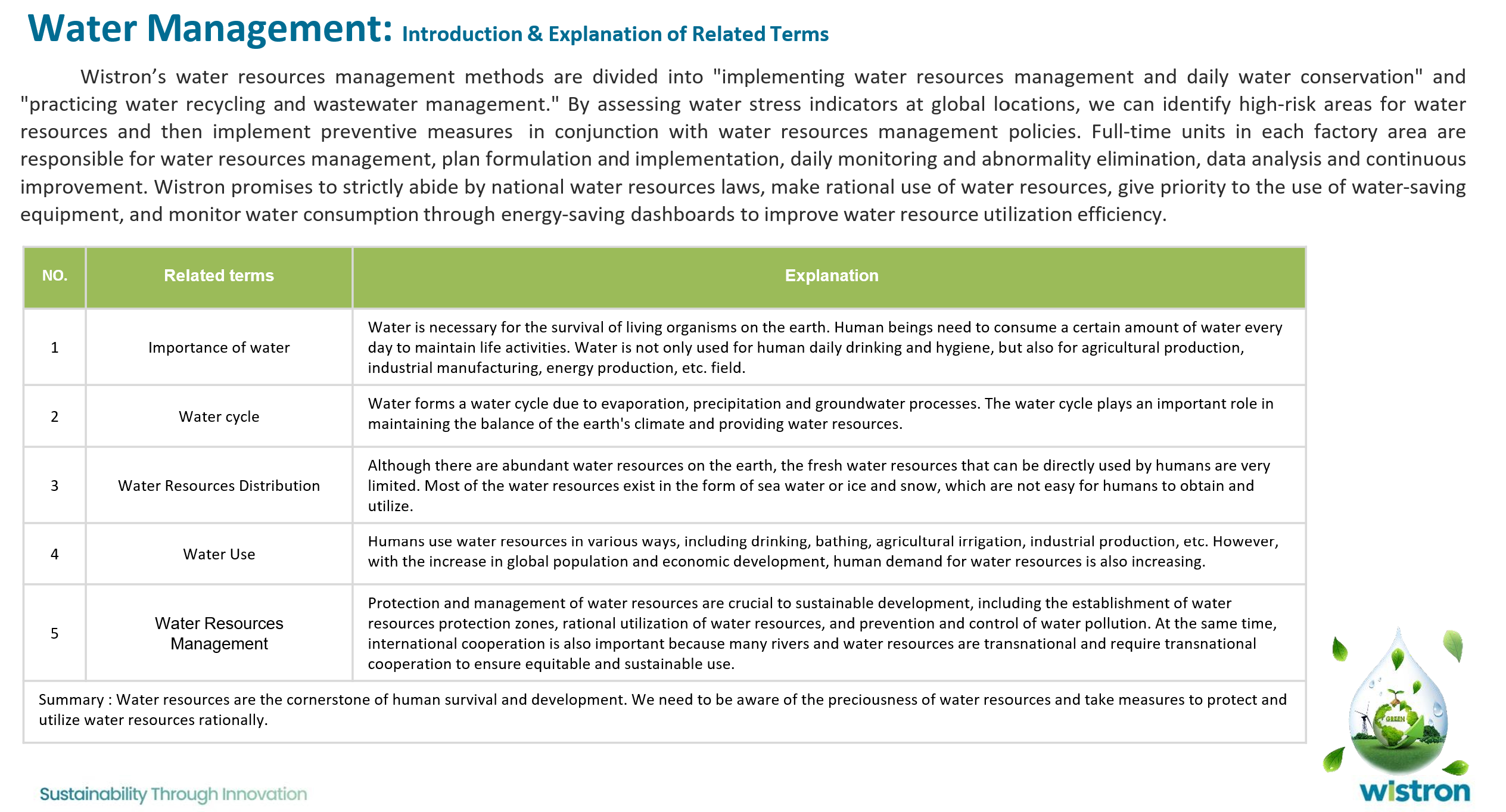
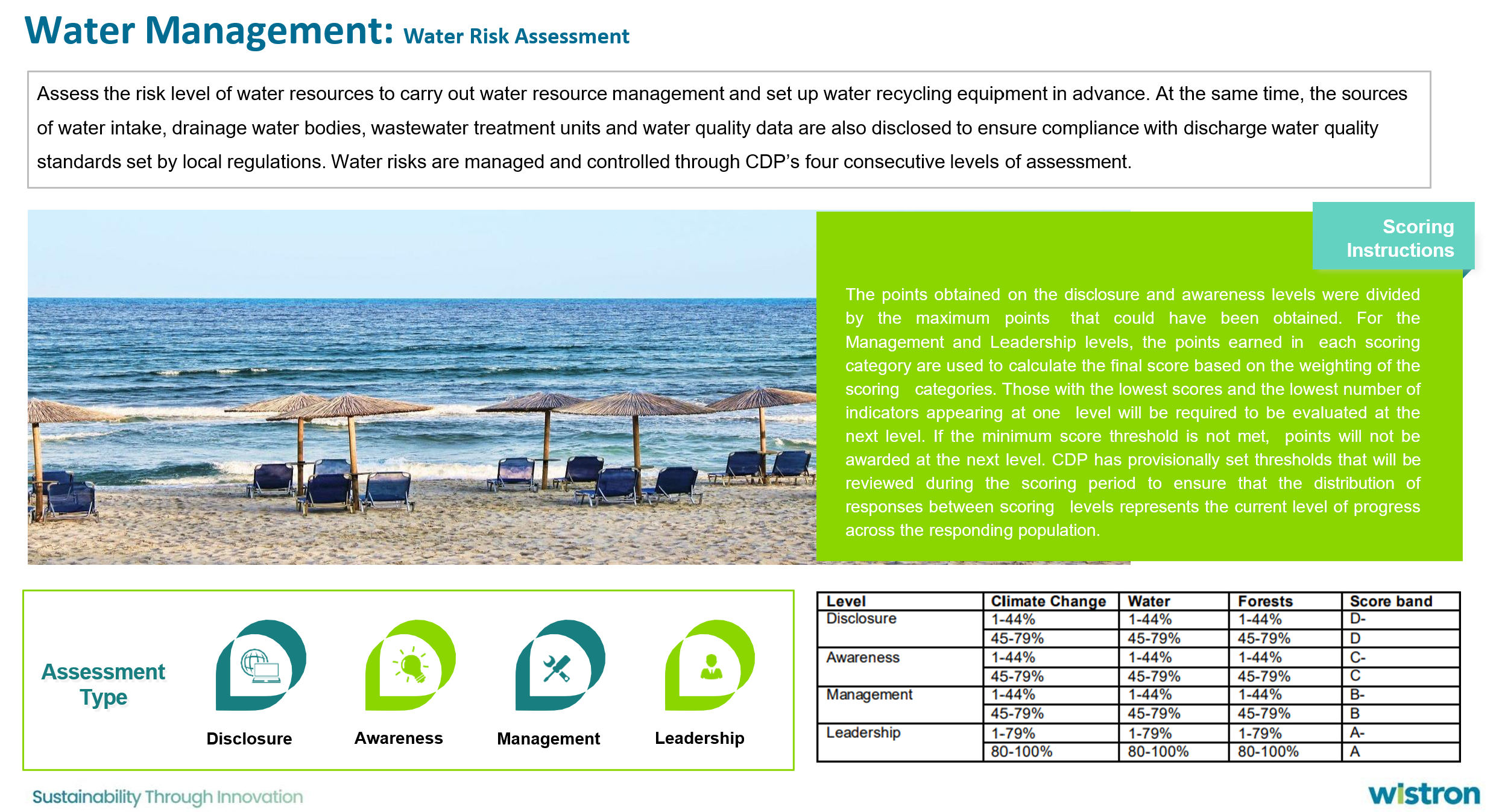
Wistron's water target in 2025 is to reduce water consumption intensity by 13% from 2022 and set more ambitious goals for medium- and long-term while continuing to track and disclose the water conservation outcomes each year.
Water Consumption
Unit: Million cubic meters
| Type |
2022 |
2023 |
2024 |
2025 |
| Total Water Withdrawal |
3.81 |
2.63 |
2.49 |
2.56 |
| Total Water Discharge |
3.02 |
2.03 |
1.95 |
2.13 |
| Total net fresh water consumption |
0.79 |
0.60 |
0.54 |
0.43 |
| Recycled & Reused Water |
0.29 |
0.16 |
0.06 |
0.00 |
- Notes 1:Total net fresh water consumption target in 2025 was 1.20 million cubic meters.
Water Usage Performance Indicators
| Type |
Unit |
2022 |
2023 |
2024 |
2025 |
| Water Usage per Unit-revenue |
kilotons of water / NT$ 1B |
5.5 |
4.0 |
3.6 |
2.1 |
| Water Recycling Rate |
Percentage (%) |
7.65 |
6.27 |
2.34 |
0.02 |
- Notes 1:2025 performance indicators are based on water withdrawal/Wistron Group revenue from Wistron and subsidiaries listed in consolidated financial statements (excl. Wiwynn and its subsidiaries).
- Notes 2: Figures for other years were tallied according to the disclosure boundaries from respective sustainability reports.
- Notes 3: In 2025, total water withdrawn was 2,561.57 cubic kilometers, of which 554.78 cubic kilometers (21.66%) were withdrawn from regions with high or extremely high baseline water stress. Total water consumed for the year was 427.51 cubic kilometers, of which 68.19 cubic kilometers (15.95%) were in regions with high or extremely high baseline water stress.
Actions and Results
01 | Reduce water consumption
To operationalize its water conservation policy, Wistron set a 2025 target to reduce water use intensity by 13% compared to the 2022 baseline. Through rigorous water management reviews and daily conservation actions, the Company systematically enhanced its water efficiency. These mitigation initiatives are structured into three key dimensions: daily conservation, recycling, and management. Consequently, the Group achieved a total water savings of approximately 66,566.42 cubic meters in 2025, slashing its water use intensity by 62% against the 2022 baseline. Although Wistron’s water profile is primarily driven by domestic consumption, the Company remains dedicated to maximizing water efficiency, capturing cost savings, and advancing sustainable development.
| Type |
Actions |
Annual Water Savings (M3) |
| Daily conservation |
Water supply regulation in domestic water use zones |
2,450.20 |
| Recycling |
-
HVAC Condensate Recovery
-
Wastewater Recovery
|
573.40
|
| Management |
-
Routine inspection and leak detection
-
Automated Irrigation Facilities
|
63,542.82
|
| Total |
66,566.42 |
02 | Water Recycling Practices and Wastewater Management
Water Recycling Practices
Effective water management can drastically decrease corporate water consumption and simultaneously decrease water withdrawal from natural water bodies, thereby lowering reliance on water ecosystems. Wistron’s water recycling efforts are structured around utility systems and process management, which encompass initiatives such as HVAC condensate recovery as well as wastewater reclamation and reuse, actively optimizing water resource utilization across its global locations.
Wastewater Management
Wistron has embedded sustainability into its operations across the organization. All global sites strictly implement environmental compliance management and, through a segregated management approach, classify wastewater into domestic wastewater and process wastewater.
-
Domestic Wastewater: Treated through multiple purification processes, including primary and secondary anaerobic treatment and clarification facilities, to ensure that effluent quality exceeds regulatory standards.
-
Process Wastewater: After treatment through collection tanks, reaction tanks, and other treatment units, the wastewater is discharged into designated local sewer networks and conveyed to wastewater treatment plants for centralized treatment.
Through these Standard Operating Procedures (SOPs) and advanced treatment technologies, Wistron enhances the quality of its wastewater discharges and is committed to minimizing environmental impacts while fulfilling its commitment to responsible water stewardship.