Compensation Policy
As part of Wistron’s commitment to our Six Sustainability Strategies, including Labor Welfare, and in support of our living wage pledge, Wistron provides compensation and benefits that meet or exceed local legal requirements. These include, but are not limited to, an employee stock trust in Taiwan and a 401(k) plan in the United States. We believe that every employee has the right to earn a living wage that is sufficient to meet basic needs while providing a degree of discretionary income.
Wistron is committed to pay equity across geographical location, race, ethnicity, socioeconomic background, social class, lineage, religion, physical disability, gender, sexual orientation, pregnancy, marital status, union membership, political affiliation, and age. Rewards and bonuses are comprehensively considered in the total package for employees, which includes salary, benefits, bonuses, and remunerations.
Furthermore, the ESG report discloses the average ratio of salary and compensation between female and male employees, with the gender pay gap across all job levels maintained at less than 6%. This is accomplished through an annual review of gender pay gaps and leveraging salary survey reports published by consulting firms to make necessary salary adjustments, thereby realizing the principle of equal pay for equal work between men and women. In addition to maintaining the fairness of the salary structure, other related optimization measures are listed as follows: (1) Formulating a global “Diversity, equity and inclusion policy (DEI policy)” to promote equality, respect and support in the workplace with three major strategies and actions; (2) Establishing a female employee resource group “Women in Wistron (WIW)” to promote support and connection among female employees; (3) Setting a goal of 27% female management positions, 24% female STEM positions, and 40% female employees by 2030; (4) Implementing gender equality policies in recruitment, working hours and work patterns, leave, performance evaluation, training and development, etc. to complement the implementation of a fair salary system. For details, please refer to the "Wistron Human Rights Due Diligence Management Report".


Selected as a constituent of the Taiwan High Compensation 100 Index
Wistron regularly engages external consultants to conduct market compensation benchmarking studies covering leading companies in the regions where its major operations are located. In addition, the Company references industry-wide compensation survey data and local economic indicators to assess compensation competitiveness and develop compensation strategies, ensuring that salary levels remain competitive.
For overall compensation, the fixed components (salary and benefits, etc.) are set in line with the competitive salary levels in regions with a major Wistron presence. The variable components (bonuses, remuneration, etc.) are determined based on a comprehensive assessment of both company and individual performance. The higher Wistron’s operational achievements and individual performance appraisal results, the higher the percentage of variable compensation in the overall salary structure. The annual bonus part of variable compensation is determined based on the Company’s performance and with reference to prevailing market levels. The total bonus pool, as well as its allocation, is proposed by the Compensation Committee and approved by the Board of Directors prior to distribution. The performance appraisal criteria are based on the attainment of comprehensive goals such as annual financial performance (revenue, profit, etc.), market/customer targets, and organizational and personnel growth/development. These criteria are reviewed and determined at the beginning of each year in consideration of both internal business conditions and external market landscapes. In addition, Wistron has established compensation measures that link rewards to Company performance, shareholder interests, and ESG performance indicators in order to recognize outstanding employees and retain key talent.
Wistron aims to enhance operational efficiency and increase employee income levels. To provide employees with excellent benefits, Wistron ensures that all employees are covered by insurance and benefit programs that comply with or exceed local legal requirements, starting from their first day of employment at any of our global offices. We also factor in local regulations, industry standards, as well as the business performance of operating locations when issuing bonuses. The salary conditions at major Wistron regions are detailed in the following table. Historical figures on number, average salary, and median salary for non-executive full-time employees in Taiwan can be found on the Market Observation Post System.
Entry-Level Wage to Local Minimum Wage
| Region |
Taiwan |
China |
Asia |
Europe |
Americas |
| Percentage |
1.1 |
1.5 |
1.5 |
1.4 |
1.5 |
Note:
1. Local minimum wage is based on local minimum wage regulations as of December 2025.
2. Wistron adopts an equal remuneration policy, where salaries are not differentiated based on gender.
3. Salary of entry-level staff refers to the monthly fixed salary of employees at the lowest level in each region.
4. Scope: subsidiaries that are manufacturing plants and after-sales service sites.
Compensation by Gender
| Item |
Level |
2025 (Femal : Male) |
| Fixed Salary |
Senior Managers |
0.96:1 |
| Management Level |
0.94:1 |
| Non-Management Level |
1.00:1 |
| Annual Salary |
Senior Managers |
1.09:1 |
| Management Level |
0.96:1 |
| Non-Management Level |
0.96:1 |
Note: Scope includes subsidiaries that are manufacturing plants and after-sales service sites.
Long-Term Incentives
| Measures |
Eligibility |
| Wistron offers an " Employee Stock Ownership Trust” (ESOT) program. Under the provisions of the Shareholders' Meeting Charter, employees may join the program and contribute a fixed amount each month based on their job level. The Company will match the employee’s contribution every month, and the contributions will be used to purchase Wistron stocks that will be held and managed by a financial institution in the stock ownership trust account. |
All full-time indirect employees in Taiwan who have completed one year of employment at Wistron are eligible to join the program. |
Restricted Stock Awards (RSAs)
In order to attract and retain business professionals, motivate employees and enhance solidarity, to further the combined interests of the Company and its shareholders, Wistron issued Restricted Stock Awards to key employees in 2020. In the event of significant risk incidents, internal mismanagement, or personnel misconduct that severely impacts the company’s reputation or results in substantial losses, the disbursement of the CEO’s bonus may be affected. Measures such as clawback, reduction, or non-disbursement of the bonus will be implemented as appropriate.
Linking Long-Term Incentives with Sustainability Performance
Wistron integrates sustainable development into one of the four core values for employees, serving as a reference for annual performance indicators. The aim is to embed ESG culture into daily work, actively promote responsibilities towards the environment, social, and corporate governance, and co-create sustainable value.
| Four Principles of Sustainable Development Indicators |
| 1. Actively promote responsibilities towards the environment, social, and corporate governance: Understand the company’s expectations and initiatives in areas such as carbon reduction, supply chain management, employee engagement, labor rights protection, and circular economy, focusing particularly on ESG-related responsibilities. |
| 2. Collaborate with diverse ecosystem partners to explore sustainable business opportunities: Work with global influence to explore and implement opportunities for sustainable growth in the company's operations. |
| 3.Advocate for diversity and collaboration: Promote understanding and respect for different regional cultures under global operations, embracing and utilizing unique perspectives and skills. Use technology to facilitate collaboration among all stakeholders in the ecosystem, creating shared value. |
| 4.Demonstrate sustainable behavior in daily work: Understand measures taken by the company in environmental and social responsibilities, actively respond and assess how to adapt work practices accordingly. Propose recommendations and take concrete action. |
| Measures |
Frequency |
Method |
| Management by objectives (MBO) |
Twice a year |
At the end of every year, Wistron organizes an annual kick off meeting to explain the operational goals of the company for the next year to all managers. Direct managers then communicate the goals to the employees to reach a consensus. The goal is therefore developed top-down to all units and individuals.
While working toward goals, two-way performance communication and feedback are maintained regularly (mid-term/year-end) and when necessary. Performance evaluations are based on goal attainment and job performance during the mid-term and year-end formal appraisal. |
| Multi-dimensions |
At least yearly |
The following personnel are evaluated through multi-dimensional methods during performance evaluation in addition to the annual goal and competency performance indicators:
- Global Section Managers & Above: “360-degree feedback” from subordinates, peers, and cross-department managers according to the 360-degree evaluation process.
- Specific professionals: " 180-to-360 Degree Feedback" on Wistron’s key talents from project managers and peers
|
| Team-based performance appraisal |
Twice a year |
- During the annual performance appraisal, the Company president will approve performance rating quotas for each business group based on its achievement rate. Groups with a high operational achievement rate will be awarded a higher ratio of Outstanding and Excellent to incentivize team performance.
- Supervisors evaluate the performance of their staffs based on their team’s performance, the performance as a team member in the project team, and the individual results of each employee.
|
| Agility assessment |
ongoing |
In the agile development team, "OKRs" (Objective Key Result) are set toward goals. Depending on project needs, the team will conduct daily progress reports and frequent weekly project progress check-ups during the project period.
Supervisors also maintain a continuous understanding of employees' work status through regular and sporadic communication and meetings. They engage in ongoing discussions with their staffs, enabling them to stay updated on their work performance. Additionally, supervisors conduct regular communication sessions with their team members during the annual goal-setting period and two performance appraisal periods. These interactions allow supervisors to stay informed about their staffs' work performance and achieve agile management. |
Global Employee Engagement Survey
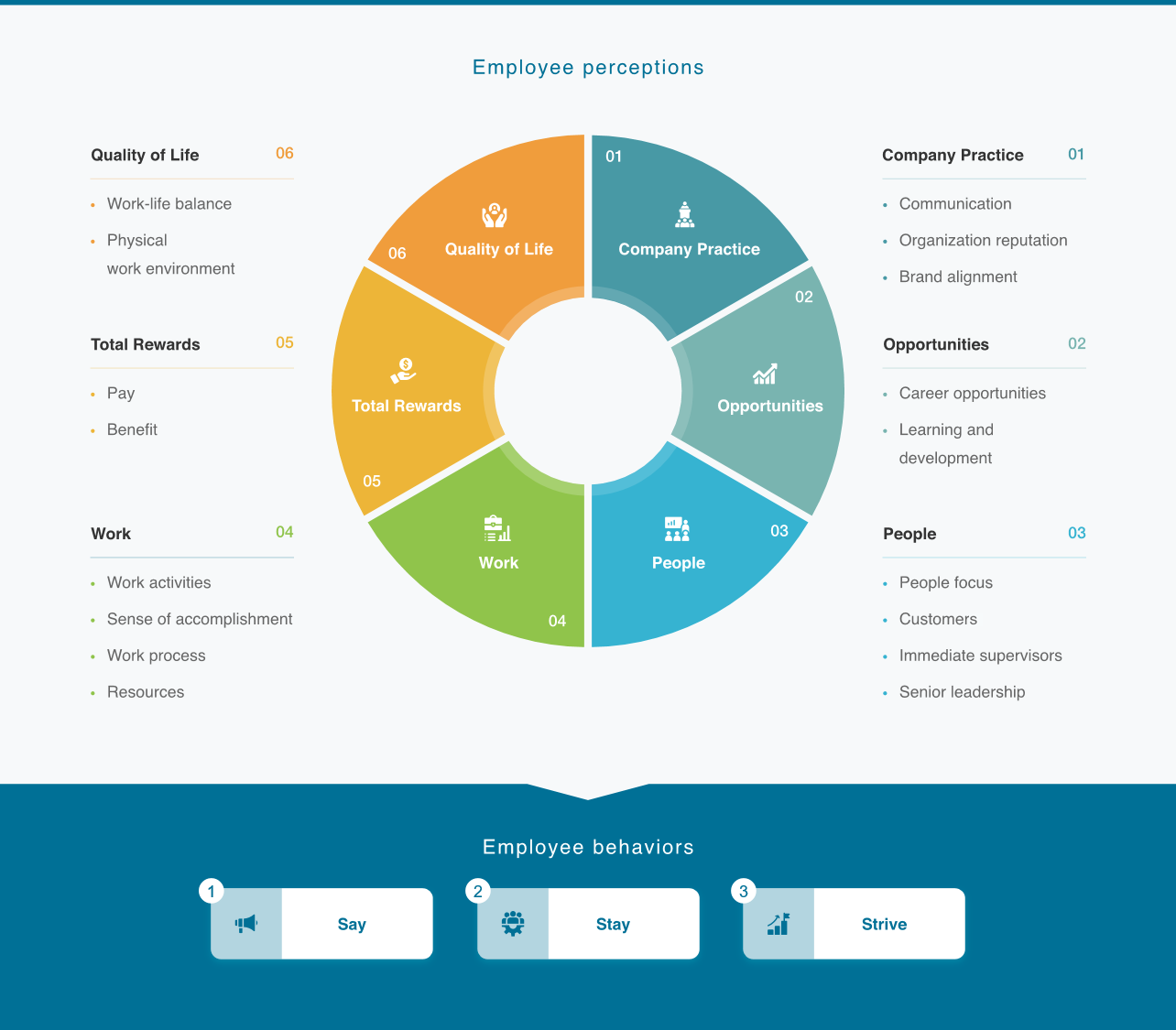
Adhering to the business philosophy of actively caring for employees, Wistron values the voices and opinions of employees. Starting from 2021, we have surveyed the opinions of all employees across all plants and departments worldwide through a census conducted every one or two years, with 100% coverage. The goals, results, and analyses are then publicly disclosed. To ensure the reliability and reference value of the statistical analysis results, the target valid response rate for each survey is set at more than 80%. To make the survey and analysis results comparable both horizontally (between factories/departments) and vertically (between years), the framework, questions and analysis methods of the survey were based on globally consistent principles and a rigorous theoretical model (please refer to the chart). The differences between groups were analyzed and compared to further enhance the effectiveness of the survey.
Through relevant survey plans, we can explore current employee engagement and gap from target value (the short- and medium-term target value is set at 70%). After the survey is completed, rigorous statistical analysis tools and methods are used to mark the groups and departments with significantly low engagement levels. The responsible departments are then required to continue collecting qualitative data (such as through focus groups, workshops, etc.) to learn more about their engagement gaps and pain points. After confirming the focus of the issue, the responsible departments will need to formulate improvement plans and performance indicators, regularly report on the implementation progress of relevant projects, and evaluate the overall effectiveness of these plans through the results of the next engagement survey.
Survey content
The survey includes the 6 employee perception items of "company practice, opportunities, people, work, total rewards, and quality of life," and 1 employee behavior item of "Say + Stay + Strive".
Questionnaire scale
They are: strongly disagree, disagree, slightly disagree, slightly agree, agree, and strongly agree. Those who answered "agree" and "strongly agree" were counted as "agree" with the description of the item. If 70 out of 100 people answer "agree" or "strongly agree", it means that 70% of the people agree with the description of the item.
Survey result - 2025
In 2025, the company-wide survey result was 68.0%, with 78.4% for indirect employees and 61.6% for direct employees. All evaluation results showed slight improvements compared to the previous year. Among these, indirect employees continued to show upward trends in the “Strive” and “Stay” dimensions, while direct employees saw the largest increase in the “Income” dimension, which rose by 12.7%. Regarding the 2025 employee engagement survey results at the company-wide level, we have established several key future work directions, summarized as follows:
1. Expanding the Scope of Communication Engagement: In addition to in-person events for managerial-level personnel, we further edit and produce video clips of related meetings, promoting them globally across operational locations through the internal learning platform;
2. Cultivating a Diverse and Inclusive Culture: This includes reviewing and optimizing existing rules, regulations, and processes; promoting awareness of Diversity, Equity, and Inclusion (DEI); facilitating diverse exchanges; and planning and operating Employee Resource Groups (ERGs);
3. Developing Employer Branding Strategies: This includes the continued internal promotion of the employee referral program; deepening external connections with campus environments; and synchronizing the talent recruitment website with social media platforms for promotion.
| Employee type |
Number of people participating in the survey |
Responses |
Response rate |
Survey results |
Target |
| Indirect employee |
18,516 |
16,359 |
88.4% |
78.4% |
66% |
| Direct employee |
27,927 |
26,617 |
95.3% |
61.6% |
| Total of 2025 |
46,443 |
42,976 |
92.5% |
68.0% |
Survey result- 2022 ~ 2025
| Year |
Number of people participating in the survey |
Responses |
Response rate |
Survey results |
| 2025 |
46,443 |
42,976 |
92.5% |
68.0% |
| 2024 |
37,689 |
34,467 |
91.5% |
65.6% |
| 2023 |
38,105 |
35,672 |
93.6% |
63.8% |
| 2022 |
45,048 |
41,053 |
91.1% |
62.4% |
Employee Turnover
In 2025, the turnover rate for Wistron’s indirect employees was 8.51%, which translates to an average monthly turnover rate of 0.71%. Compared to our industry peers, this turnover rate indicates stability and a healthy work environment. For direct employees, the nature of the industry, characterized by seasonal orders and fluctuating production capacity, has significant implications on workforce planning such as periodic large-scale recruitment and turnover of direct employees. Additionally, direct employees account for a significant portion of Wistron’s workforce structure, comprising approximately 64% of the total employee count at the end of 2025. Consequently, the overall turnover rate for Wistron is significantly influenced by the turnover of direct employees. For more detailed statistics on employee turnover in 2025, please refer to the attached appendix.
Number of new hires globally in 2025: 50,188 people
Indirect employees turnover rate of 2025: 8.51%
Reducing Employee Turnover Rate
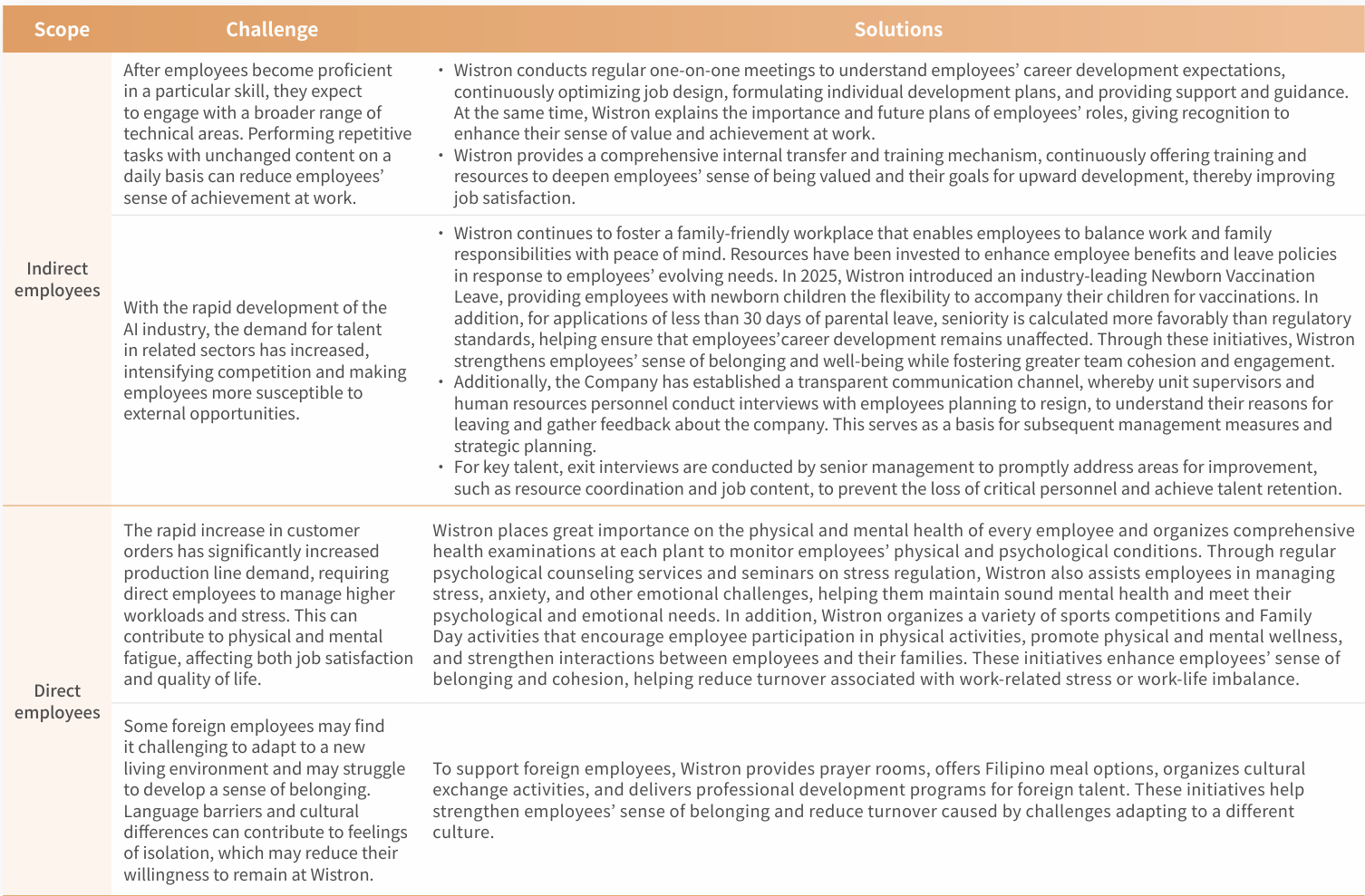
In the current competitive talent landscape, retaining excellent employees and improving employee retention rates are crucial for the sustainability of a company. To ensure talent retention, Wistron remains committed to increasing employee satisfaction, engagement, and fostering a sense of belonging. The company has designed a series of retention programs based on these principles.
Wistron utilizes various activities and initiatives to enhance employee engagement and satisfaction. The company believes that these measures will help reduce employee turnover, maintain team stability, and lay a solid foundation for the company's long-term development. Moving forward, Wistron will continue to optimize these programs to ensure that employees have more opportunities for growth and development within the company.
Resignation statistics and distribution
Total turnover rate
Voluntary turnover rate
| Resignation statistics and distribution |
2022 |
2023 |
2024 |
2025 |
| Total turnover rate (%) |
50.57% |
35.25% |
27.43% |
25.03% |
| Male |
54.35% |
35.79% |
28.70% |
26.82% |
| Female |
43.98% |
34.32% |
25.44% |
22.27% |
| Under 30 years old |
69.02% |
51.38% |
41.02% |
38.95% |
| 30-50 years old |
34.14% |
24.35% |
18.34% |
14.49% |
| 50 years old and above |
9.11% |
15.89% |
15.74% |
10.43% |
| Taiwan |
15.49% |
14.98% |
13.43% |
10.37% |
| China |
63.84% |
44.12% |
38.72% |
32.88% |
| Asia |
- |
41.00% |
28.53% |
32.84% |
| Europe |
23.90% |
13.29% |
12.57% |
29.11% |
| America |
57.49% |
47.21% |
18.11% |
20.74% |
| Direct employees |
71.77% |
49.46% |
39.07% |
32.65% |
| Indirect employees |
19.42% |
16.20% |
11.57% |
11.58% |
| Resignation statistics and distribution |
2022 |
2023 |
2024 |
2025 |
| Voluntary turnover rate (%) |
38.87% |
27.27% |
22.82% |
17.83% |
| Male |
41.51% |
28.19% |
24.91% |
18.94% |
| Female |
34.26% |
25.70% |
19.55% |
16.12% |
| Under 30 years old |
53.11% |
41.56% |
36.56% |
26.16% |
| 30-50 years old |
26.24% |
17.94% |
14.27% |
12.01% |
| 50 years old and above |
5.98% |
5.17% |
4.23% |
4.55% |
| Taiwan |
14.08% |
9.39% |
8.21% |
6.81% |
| China |
48.77% |
36.11% |
33.63% |
22.13% |
| Asia |
- |
23.72% |
26.64% |
26.07% |
| Europe |
3.41% |
3.15% |
3.83% |
5.17% |
| America |
48.52% |
43.77% |
14.70% |
17.00% |
| Direct employees |
55.61% |
40.23% |
32.99% |
23.11% |
| Indirect employees |
14.26% |
9.91% |
8.97% |
8.51% |
- Note: The above data does not include employees who have been employed for less than 3 months.
Employee Evaluation
Each year, all Wistron employees undergo two performance appraisals, and the results are used as the basis for rewards, assignments, promotions, and various aspects of personnel management. To achieve fair and reasonable performance management, Wistron implements a phased approach globally to promote diversified assessments. We also introduced a new performance management system. At the end of 2024, Wistron rolled out a unified performance management platform across all global locations, allowing additional reviewers to provide feedback on employees’ work and competencies, offering supervisors multi-dimensional references for their assessments and ensuring a more equitable and consistent management system. In 2025, 100% of employees regularly underwent appraisals.
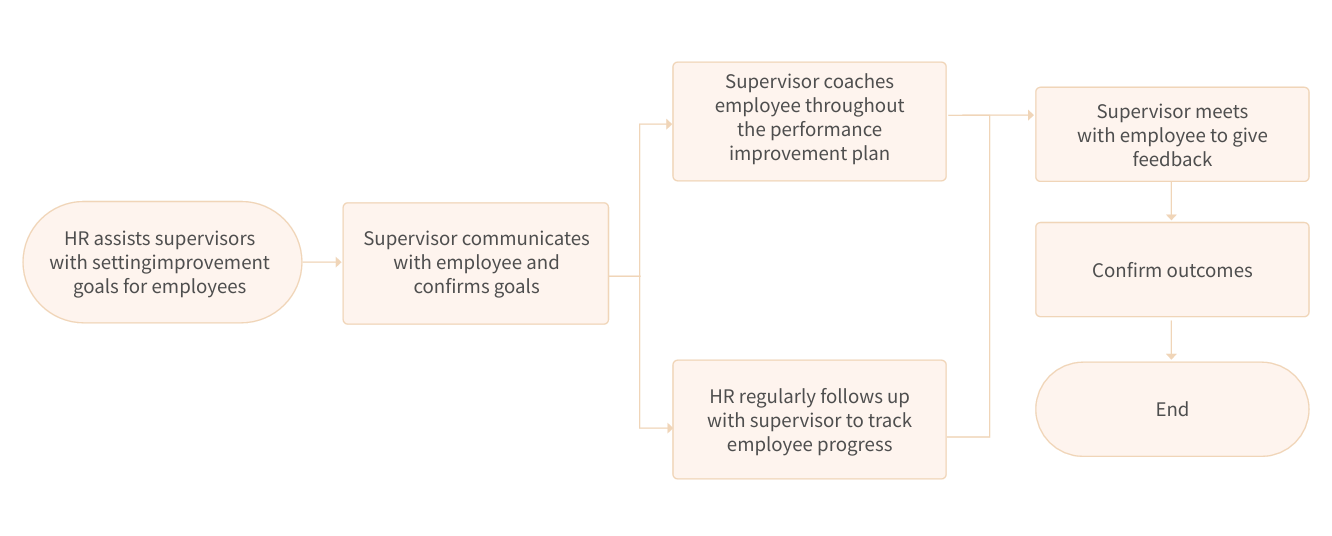
To enhance overall organizational performance, the HR units continue to offer training programs for supervisors, equipping them to initiate performance improvement plans for employees whose performance requires development. Under these plans, HR works closely with supervisors to set specific, measurable improvement goals for the employee. Weekly one-on-one meetings are arranged between the supervisor and the employee to monitor progress and discuss improvements.
Through frequent and in-depth two-way communication, supervisors can provide constructive direction and timely feedback, promptly address areas needing improvement, and effectively support performance improvement among employees and across departments. In 2025, improvement plans for employees had a 100% implementation rate. This initiative reflects Wistron’s commitment to employee development, ensuring we remain competitive in a dynamic market.