
AI-Driven Digital Transformation
AI-Driven Digital Transformation
Bridging Industry Gaps and Defining the New AI+ Era Through Tangible Results
In 2025, AI is no longer a value-added advantage for businesses but also a foundational driver of competitiveness. According to projections by PwC and Gartner, AI is expected to contribute US$15.7 trillion to the global economy by 2030, while global AI-related spending is projected to approach US$1.5 trillion in 2025. AI has evolved beyond individual projects into a core "infrastructure-level" capability.
While 88% of enterprises have attempted to adopt AI, McKinsey notes that only 1% have successfully scaled their deployment. Accenture's research further indicates that only 12% of companies qualify as “AI Achievers,” and these organizations achieve revenue growth rates that are 2.5 times higher than those of their industry peers. This demonstrates that AI's true value lies not in whether it is adopted but in whether enterprises possess governance capabilities and achieve scaled impact.
Wistron's Strategy: From "+AI" to "AI+" DNA
Wistron has chosen to lead the curve, elevating our strategy from tool-side "+AI" to mindset-side "AI+" through a three-stage design that builds organizational resilience:
- AI Lab: Validate use cases.
- AI Factory: Drive standardized scaling.
- AI as Technology Service: Transform internal capabilities into external services.
Practical Impact: Data-Driven Innovation and Sustainability
AI has become an important enabler of innovation across Wistron, transforming from traditional manufacturing into a true AI-Driven Enterprise. From 2022 through the end of 2025, Wistron's transformation has yielded significant results:
- Financial Benefits: Completed nearly 100 AI innovation use cases.
- Universal Application: Covers manufacturing, R&D, supply chain, finance, and HR.
- International Recognition: Awarded two WEF Global Lighthouse Factory certifications.
- Continuous Innovation: Selected as a Top 100 Global Innovator for four consecutive years.
Three Core Pillars + Four Innovation Strategies + Five Success Keys
Wistron's transformation is not a series of isolated attempts but a dual-track progression from top-down and bottom-up, forming a continuously replicable and iterative approach.
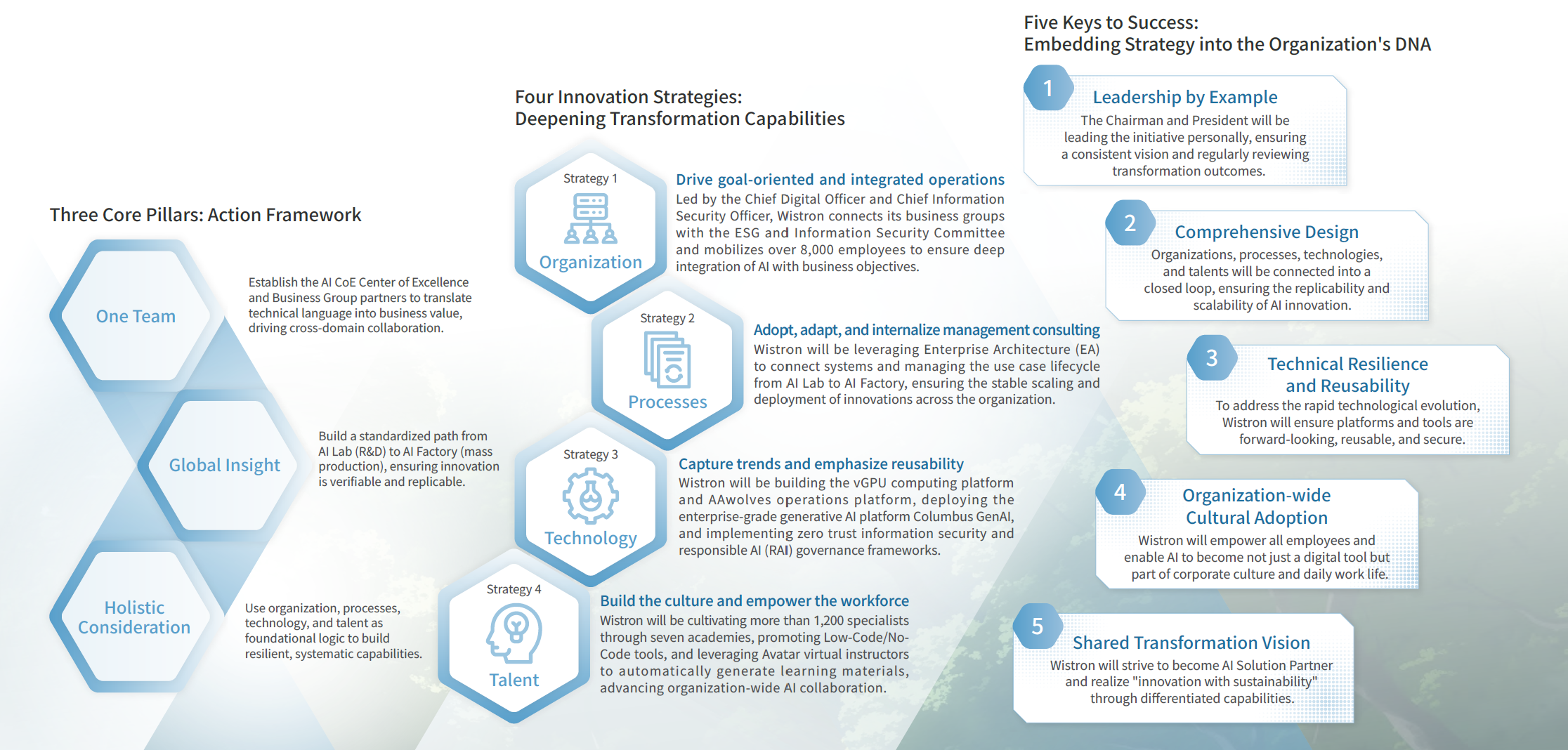
From Hundreds of Use Cases to Full-Scale Adoption: A Comprehensive View of Wistron's AI Transformation
Since 2022, Wistron has implemented nearly one hundred AI innovation initiatives. By advancing AI across organizations, processes, technologies, and talent development in parallel, the Company has realized smart management across its large and complex operating environment, creating measurable value for both the Company and its customers.
Making AI the Working Language of Every Employee
With "AI First" as the cultural anchor, Wistron has established four organizational platforms—AI CoE, AI Biz Partner, AI Lab, and AI Factory—to ensure the orderly roll-out and effective deployment of AI applications across diverse business scenarios. Using a Low/No-Code enterprise-grade data science platform as the foundation, combined with large language models (LLM) for pain point inventory, data exploration and analysis, with version control and reproducible reports, Wistron balances innovation momentum with governance requirements.
In talent development, conducted 12 cohorts of internal AI training programs and cultivated more than 1,000 AI seed talents, transforming AI capabilities from a specialized skill held by the few into a shared tool and language for all employees. The goal is to shift the human-AI collaboration structure from "20% AI + 80% manual" to "80% AI + 20% manual," freeing employees from tedious tasks to focus on higher-value analysis and decision-making, while simultaneously enhancing per capita productivity and operational resilience.
Turning Innovation into a Moat: 224 Patent Applications Strengthen Wistron's AI Advantage
Since 2021, Wistron has systematically advanced its intellectual property strategy, filing 224 patent applications across key areas such as enterprise-grade generative AI platforms and agent frameworks, model operations and security governance, digital twins and physical-virtual integration, and smart supply chain and process optimization. This well-structured patent portfolio not only strengthens Wistron's technological moat but also opens up commercial avenues for future licensing partnerships.
From Tools to Partners: Agentic AI Driving Process Transformation and Universal Innovation
With Agentic AI at its core, Wistron is driving innovation and process transformation. The enterprise-grade generative AI platform Columbus integrates more than 70 business knowledge bases, supports multimodal input, and uses an AI Agent Builder to lower technical barriers, empowering non-technical employees to autonomously design process-oriented smart assistants and upgrading the platform from "passive Q&A" to actionable intelligence.
Intelligent Agents: Empowering Services to Seek Out Employees
By the end of 2025, employees had independently developed nearly 1,000 AI Agents, with nearly 120 of these agents integrated into project system processes. In supply chain management, for example, smart agents automatically integrate order information, monitor material availability in real time, issue shortage alerts, and proactively suggest alternative materials. This shifts the working model from “people seeking services” to “services reaching people.”
AI Coding: Systematic Leap in R&D Efficiency
In software development, over 80% of engineers have incorporated AI Coding into their daily work, with smart assistant collaboration from requirements analysis, version control, and test validation to document generation, advancing R&D efficiency from isolated tools to systematic momentum.
Digital Twin: Virtual World Testing for Flawless Manufacturing
In manufacturing and engineering, Wistron uses physical-virtual integration and digital twin technologies as key enablers of manufacturing innovation. Before physical construction begins, the company builds virtual factories and simulates production lines, processes, and parameter optimization to eliminate potential errors and bottlenecks in advance. Key achievements include:
- 70% reduction in process preparation time
- Up to 85% improvement in AI-assisted design efficiency
- Nearly 3,500 reusable 3D components and models accumulated, exponentially increasing factory construction and production line simulation speed
Empowering ESG with AI
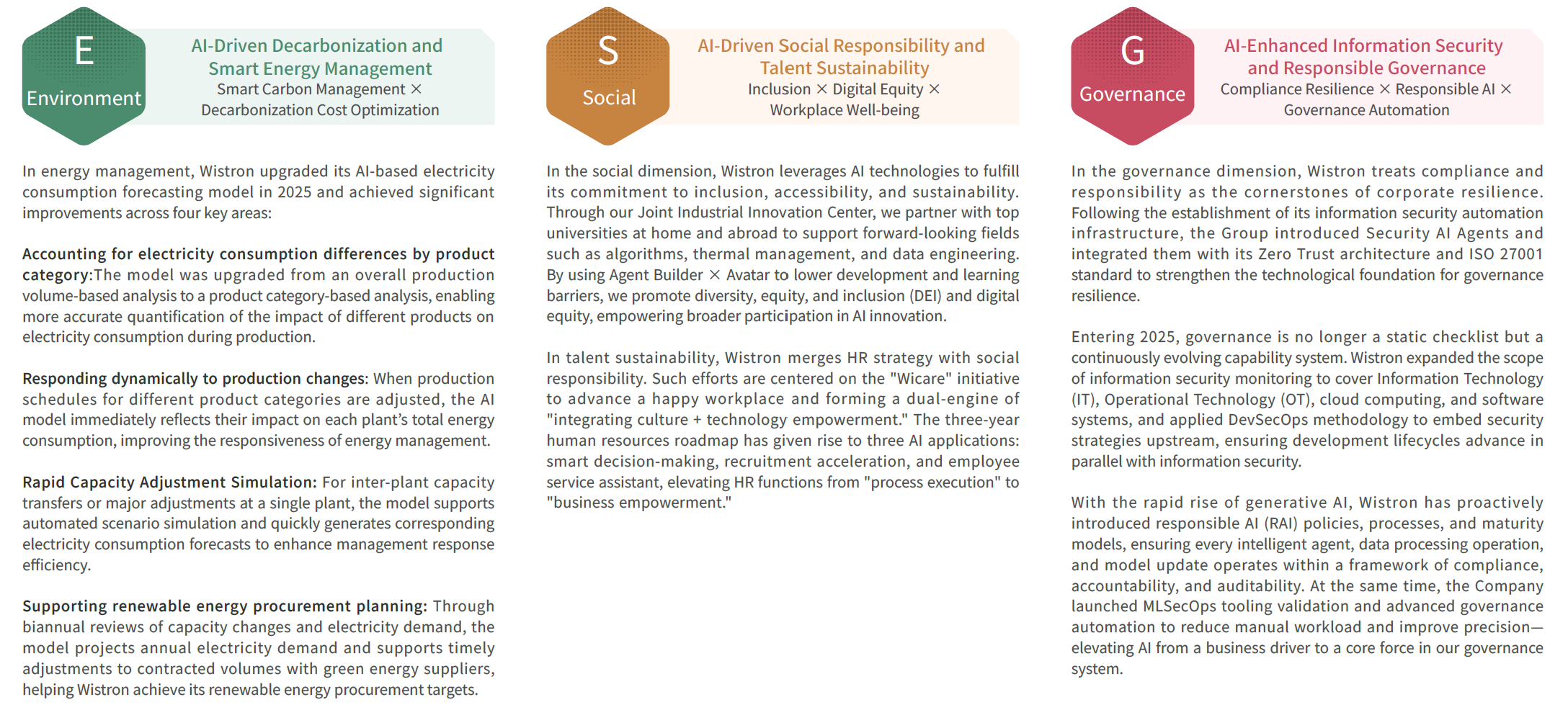
The rapid development of generative AI, while enhancing productivity and creativity, also places greater demands on organizational governance and risk management. Wistron remains committed to the deployment of Responsible AI, capitalizing on AI to create maximum value in an ethical manner while minimizing potential risks. In 2025, we deepened the effectiveness and comprehensiveness of AI governance in four key dimensions.
1. Clear Accountability Framework and Role Division
The Information Security Executive Committee serves as Wistron’s dedicated governance body for RAI, with an RAI Functional Group established under the Committee to oversee the planning and implementation of related governance initiatives. Clear division of responsibilities effectively enhances the efficiency and transparency of the AI governance system, reinforcing the organization's foundation in AI risk management.
2. RAI Policies and Management Guidelines
In 2025, three core documents were officially issued and put into effect: the Responsible AI System Policy, the Responsible AI Stakeholder Operating Procedures, and the Responsible AI Education and Training Management Guidelines. These three guidelines establish a consistent management foundation for the AI governance framework, creating a systematic PDCA iterative cycle for optimization.
3. Automated Deployment, Detection, and Monitoring
Wistron initiated in-depth evaluation and development of RAI-related tools, conducting Proof-of-Concept (PoC) testing of MLSecOps mechanisms to enable end-to-end deployment, detection, and monitoring of AI systems. This mechanism rapidly identifies and addresses potential risks, effectively reduces manual workload, and significantly enhances management precision and efficiency.
4. Education and Practical Training
In 2025, we conducted 12 training sessions across two themes: AI Development Lifecycle and RAI Tools. Participants included members of the AI Platform Team, seven cross-functional use case teams, and governance document owners. By evaluating and deploying appropriate tools and integrating governance requirements into operational documentation, Wistron has established an iterative “Learn–Validate–Optimize” framework. This mechanism allows governance practices and R&D processes to be refined concurrently through real-world implementation, fostering a virtuous cycle of continuous improvement.
AI Enterprise Foundation: Toward an AI-Driven Enterprise
Wistron has established a recurring three-year rolling planning mechanism. Each Q3, PMOs across functional areas will conduct comprehensive reviews that incorporate both external trends and internal needs. Then, in Q4,, the President will approve the strategic blueprint for the next planning cycle, ensuring forward-looking and consistent mid-to-long-term execution.
Looking ahead to 2025-2027, we have officially launched the major strategic project AI Enterprise Foundation. Centered on the vision of strengthening the foundation and building enterprise-grade infrastructure to enable the scalable growth of AI, the initiative will advance through three strategic pillars:
The goal is clear and unwavering: Make Wistron an AI-Driven Enterprise. Wistron will continue to connect with customers, suppliers, and academic institutions to form a robust AI ecosystem. Through Decision Intelligence, the Company will integrate AI into the core of business decision-making and successfully transform from traditional contract manufacturing into a technology services enterprise. While achieving business growth, we use the power of technology to address environmental and social challenges, realizing our long-term vision of "innovation with sustainability."
Wistron has established a recurring three-year rolling planning mechanism. Each Q3, PMOs across functional areas will conduct comprehensive reviews that incorporate both external trends and internal needs. Then, in Q4,, the President will approve the strategic blueprint for the next planning cycle, ensuring forward-looking and consistent mid-to-long-term execution.
Looking ahead to 2025-2027, we have officially launched the major strategic project AI Enterprise Foundation. Centered on the vision of strengthening the foundation and building enterprise-grade infrastructure to enable the scalable growth of AI, the initiative will advance through three strategic pillars:
| Responsible AI Responsible AI Governance |
Foundational AI Flexible Technology Platform |
Cultural AI AI First Culture |
| Wistron will continue to strengthen its Responsible AI (RAI) framework by establishing an automated governance platform and MLSecOps mechanisms. The Company will align practices with the timelines and requirements of the EU AI Act, ISO 42001, and the NIST AI Risk Management Framework (AI RMF), ensuring that AI applications operate within a compliant, transparent, and governable framework. | Wistron will establish AI Ops Center and AI Data infrastructure capabilities, and leverage an AI Computing resource management platform to optimize the sharing and allocation of computing resources and enhance asset utilization efficiency. | Wistron will work closely with Human Resources to identify emerging talent needs under AI-driven operating models. Through its AI Capability Center and change management mechanisms, the Company will build AI capabilities across the organization and embed an AI mindset into employees’ daily work. |
The goal is clear and unwavering: Make Wistron an AI-Driven Enterprise. Wistron will continue to connect with customers, suppliers, and academic institutions to form a robust AI ecosystem. Through Decision Intelligence, the Company will integrate AI into the core of business decision-making and successfully transform from traditional contract manufacturing into a technology services enterprise. While achieving business growth, we use the power of technology to address environmental and social challenges, realizing our long-term vision of "innovation with sustainability."