Wistron’s Product Carbon Footprint System Successfully Completes Third-Party Agreed-Upon Procedures
2026.11.19
News

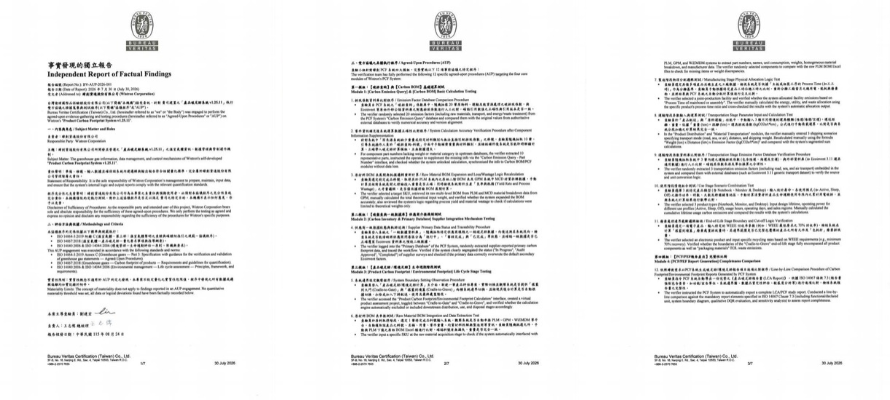
In response to the global net-zero transition and increasing customer demand for greater transparency in product carbon information, Wistron’s self-developed Product Carbon Footprint (PCF) System has successfully completed a third-party Agreed-Upon Procedures (AUP). The AUP was conducted by Bureau Veritas Certification (Taiwan) Co., Ltd. in accordance with the relevant requirements of ISO 14064-3, ISO 14067 and ISO 14040. The assessment confirmed that the system’s core mechanisms, including product lifecycle carbon footprint calculation, supplier primary data management, and report generation, are built upon a comprehensive and traceable operational framework. This achievement marks an important milestone in Wistron’s digitalization of product carbon management and value chain decarbonization efforts.
As corporate climate responsibilities increasingly extend beyond operational boundaries to encompass the entire value chain, product carbon footprints have become a critical foundation for supply chain management and low-carbon product development. Wistron has long integrated climate action into its sustainability strategy and adopted “prioritizing actual reductions within the value chain” as its core decarbonization principle. To enhance the quality and efficiency of carbon data management, Wistron launched its self-developed PCF system in 2023, integrating data from all stages of the product lifecycle. The system covers raw material sourcing, manufacturing, transportation, product use, and end-of-life treatment, enabling product development teams to identify carbon hotspots and uncover opportunities for improvement.
Unlike conventional verification approaches that focus solely on carbon footprint results, this third-party review also examined the underlying operational mechanisms of Wistron’s PCF system. The AUP covered four core system modules, including emission factor management, primary data application, lifecycle carbon emissions calculation, and report generation. Through data traceability reviews, cross-system data integration checks, and lifecycle scenario testing, the assessment confirmed that the system possesses robust data integration, calculation, and management capabilities that align with relevant international standards.
Through its PCF system, Wistron is able to effectively monitor carbon emissions throughout the product lifecycle while supporting the collection and application of supplier primary carbon footprint data. Compared with approaches that rely solely on generic databases, the use of primary data enhances the accuracy and representativeness of product carbon footprint information, providing a stronger basis for low-carbon product design and supply chain decarbonization initiatives. Looking ahead, Wistron will continue to enhance system functionality, expand the collection and application of primary data, and deepen collaboration with supply chain partners on emissions reduction initiatives. Through digital tools and data-driven management, Wistron remains committed to advancing its climate transition strategy and steadily progressing toward its 2050 net-zero emissions goal.