Policies and Commitments
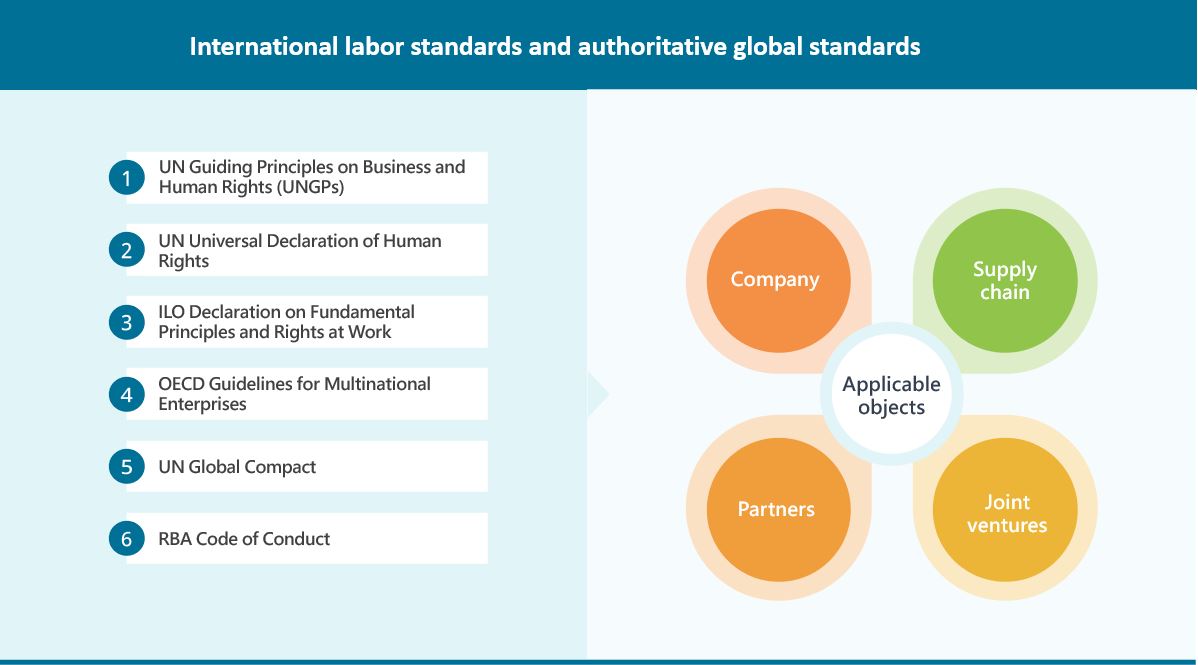
Wistron’s human rights policy underscores its support and compliance with international labor and human rights standards, such as the United Nations Universal Declaration of Human Rights, United Nations Guiding Principles on Business and Human Rights, International Labor Organization Declaration on Fundamental Principles and Rights at Work, Organization for Economic Cooperation and Development Guidelines for Multinational Enterprises, Responsible Business Alliance Code of Conduct, etc. The policy applies to all Wistron stakeholders, including the Company and our supply chain, partners, joint ventures, etc., and also clearly describes the content of human rights commitments and related management principles.
Human Rights Due Diligence
To ensure effective implementation of human rights policies in all Wistron locations around the world, we established a human rights due diligence management procedure (shown in figure above) in 2020. Starting from 2021, we have conducted annual due diligence for the Company's own operating scope (such as employees, direct activities, products and services). A complete management cycle is implemented every year in order to establish a consistent culture and behavioral standards for the entire group that effectively manage and reduce human rights risks and truly respond to company policies and the expectations of all stakeholders.
The first stage focuses on policy development and assessment, beginning with the establishment and review of the Human Rights Policy, followed by risk analysis and the identification of material topics to determine annual management priorities. The second stage focuses on implementation, translating policies into management procedures and practices and validating their effectiveness through on-site risk assessment activities, such as RBA VAP audits, self-assessments, and SAQs. The third stage focuses on review and improvement, consolidating implementation and assessment results into management review reports, developing corrective action plans for identified gaps, and continuously tracking progress. The final stage strengthens communication and transparency through training, grievance channel promotion, and public disclosure. The cycle then returns to the first stage, creating a continuous process of improvement.
For the supply chain, Wistron has established a Sustainable Supply Chain Audit Program to regularly audit and assess the operational risks of key suppliers. The scope covers five major sustainability topics: sustainability and operational risk management, sustainable supply chain management, environmental protection, human rights and labor protection, and occupational health and safety. To comprehensively assess the implementation of sustainability practices among suppliers, Wistron adopts a diversified assessment approach, including both desk assessments and on-site assessments. If a supplier receives an audit score below 80 points, Wistron will require the supplier to submit corrective actions for all identified non-conformities. Suppliers must complete the improvements and apply for re-audit within two months. Suppliers that fail the re-audit may not apply for another re-audit within six months. If audit findings are determined to potentially affect the quality of supplied materials, Wistron will immediately initiate an evaluation process to replace the material and/or supplier.
Based on the 2024 internal human rights risk assessment, Wistron targeted several major human rights issues in 2025 and required each site to formulate risk mitigation measures and regularly track progress toward relevant indicators. Focusing on human rights issues such as “at least 1 day off in 7 days,” “<60 total working hours per week,” “payroll accuracy,” “working hours management system audit pass rates,” and other human rights issues, we proposed 37 optimization measures across 27 sites.
Despite a continued increase in audited sites (from 25 sites in 2024→27 sites in 2025), the percentage of items rated as medium- or high-risk in 2025 remained below 1% across all indicators, demonstrating effective control and no significant anomalies. (Refer to the table below for consolidated data.)
The proportion of major human rights issues assessed as medium- to high-risk projects
| 年度 |
Type of working hours |
Wages & benefifits |
Labor Management Systems |
Number of
audits |
Number
of audited
items |
| 1 day off in 7 days |
Weekly working hours <60 |
Payroll accuracy |
Working Hours Management System Audit Pass Rate |
| 2023 |
0.16% |
0.40% |
0.18% |
0.17% |
76 |
10,908 |
| 2024 |
0.22% |
0.60% |
0.21% |
0.14% |
146 |
12,545 |
| 2025 |
0.16% |
0.57% |
0.07% |
0.59% |
151 |
17,650 |